Pearson Edexcel · GCSE · Computer Science
Course version: 1CP2 · Version from Sept 2020
Understand how an interpreter differs from a compiler in the way it…
Full specification wording
Programming languages: 3.3.2 understand how an interpreter differs from a compiler in the way it translates high-level code into machine code
A compiler translates the whole high-level source program in one go, producing a machine code file that can then be run without the compiler present.
Checked against the Pearson Edexcel 1CP2 specification (opens in a new tab) on .
- Point 2 of 2
- 4 key terms
Study notes
From the checked teaching notes for this specification point.
The idea
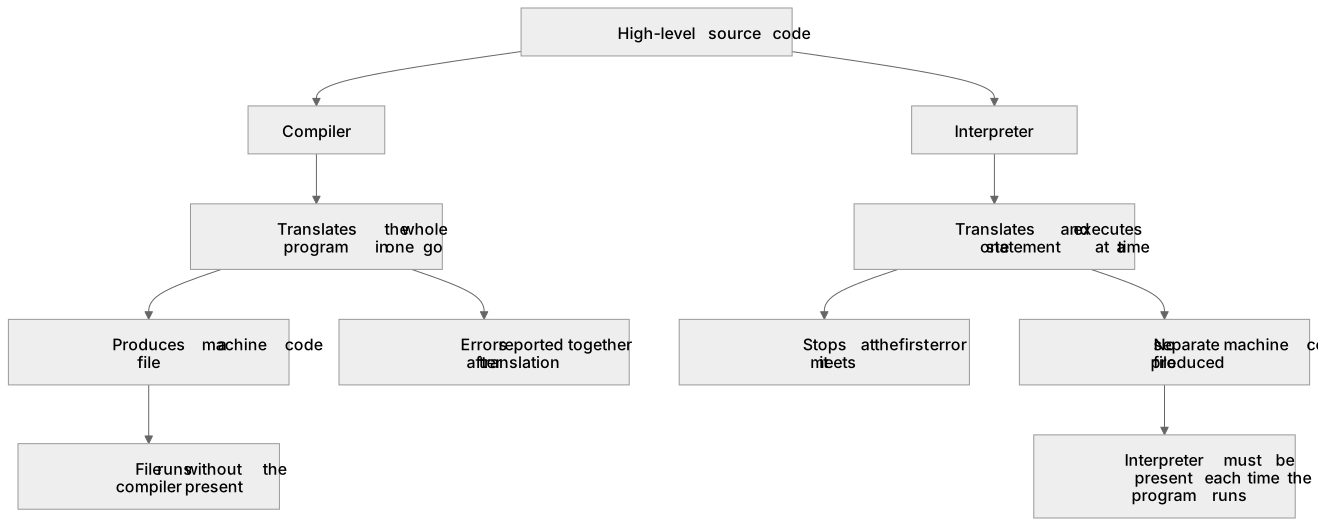
A compiler translates the whole high-level source program in one go, producing a machine code file that can then be run without the compiler present. Errors are reported together after translation, and the compiled program usually runs quickly because translation has already happened. An interpreter translates and executes the source one statement at a time, so it stops at the first error it meets and no separate machine code file is produced; the interpreter must be present each time the program runs. Interpretation suits development and testing because errors are found immediately, while compilation suits finished software that must run efficiently and be distributed without source code.
What earns the marks
- A compiler translates the entire source program before any of it is executed, producing a machine code file.
- A compiler reports errors together after translating the whole program, so several errors may be listed at once.
- An interpreter translates and executes one statement at a time, stopping when it reaches an error.
- An interpreter does not produce a standalone machine code file, so the interpreter must be available whenever the program runs.
- Compiled code generally executes faster because translation is completed in advance; interpreted code is convenient during development because errors appear immediately.
- The choice depends on purpose: interpretation for testing and learning, compilation for efficient distribution of finished software.
Common mistakes and how to put them right
Saying an interpreter translates the whole program first.
Put it right: It works statement by statement, executing as it goes.
Claiming a compiler runs the program.
Put it right: The compiler produces machine code, and the resulting file is what runs.
Thinking interpreted programs never become machine code.
Put it right: Each statement is translated into machine code as it is reached, but no complete machine code file is saved.
Believing only compilers find errors.
Put it right: Both find errors, but a compiler reports them after translating everything, while an interpreter stops at the first error encountered.
Exam tips
- Answer with the translation unit: whole program for a compiler, one statement at a time for an interpreter.
- Mention the output: a compiler produces a machine code file, an interpreter does not.
- Add the practical consequence, such as speed of the finished program or immediate error reporting, to secure the explanation mark.
Try the lesson
The start of the Programming languages: 3.3.2 understand how an interpreter differs from a compiler in the way it translates high-level code into machine code lesson, made from checked teaching notes for this specification point.
Have a go first
An interpreter is used to run a high-level program. How does the interpreter translate the high-level code into machine code?
Listen
A compiler translates the whole high-level source program in one go, producing a machine code file that can then be run without the compiler present. Errors are reported together after translation, and the compiled program usually runs quickly because translation has already happened. An interpreter translates and executes the source one statement at a time, so it stops at the first error it meets and no separate machine code file is produced; the interpreter must be present each time the program runs. Interpretation suits development and testing because errors are found immediately, while compilation suits finished software that must run efficiently and be distributed without source code. A strong answer earns marks for these points. A compiler translates the entire source program before any of it is executed, producing a machine code file. A compiler reports errors together after translating the whole program, so several errors may be listed at once. An interpreter translates and executes one statement at a time, stopping when it reaches an error. An interpreter does not produce a standalone machine code file, so the interpreter must be available whenever the program runs. Exam tip: Answer with the translation unit: whole program for a compiler, one statement at a time for an interpreter.
See it
Key words
Say what each word means before you turn the card.
Compiler behaviour
Try answering aloud or in your head before turning the card.
Interpreter behaviour
Try answering aloud or in your head before turning the card.
Errors and execution speed
Try answering aloud or in your head before turning the card.
Translation of high-level code
Try answering aloud or in your head before turning the card.
See every definition
- Compiler behaviour
- Translates the entire source program before any of it is executed, producing a machine code file, and reports errors together after translating the whole program.
- Interpreter behaviour
- Translates and executes the source one statement at a time, stopping when it reaches an error, and produces no standalone machine code file.
- Errors and execution speed
- Compiled code generally executes faster because translation is completed in advance, while interpreted code is convenient during development because errors appear immediately.
- Translation of high-level code
- A compiler translates the whole high-level source program in one go, whereas an interpreter translates and executes it one statement at a time.
Label the diagram
Some boxes have lost their names. Pick the right name for each number.
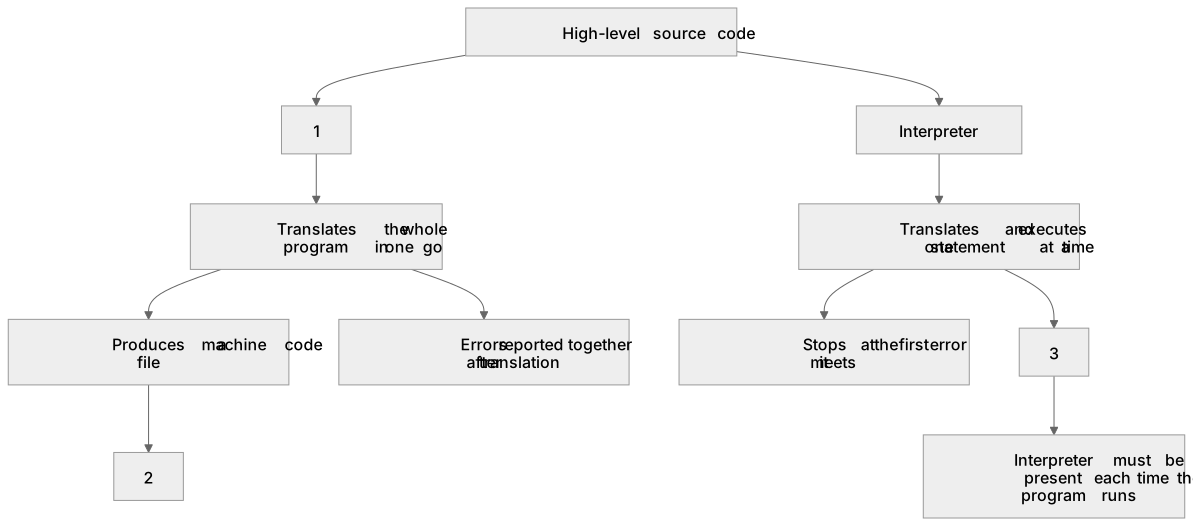
1Box 1
2Box 2
3Box 3
There is more to this lesson
The full lesson goes on to check your understanding and help you earn the marks. Create a free account to carry on, with your progress saved.
A week of Premium from your first lesson · Then the free plan continues · No card, no charge
Test your understanding of Programming languages: 3.3.2 understand how an interpreter differs from a compiler in the way it translates high-level code into machine code
Active recall beats re-reading. Take an instant quiz now to test what you’ve learned and lock it into long-term memory.
A week of Premium from your first lesson · Then the free plan continues · No card, no charge